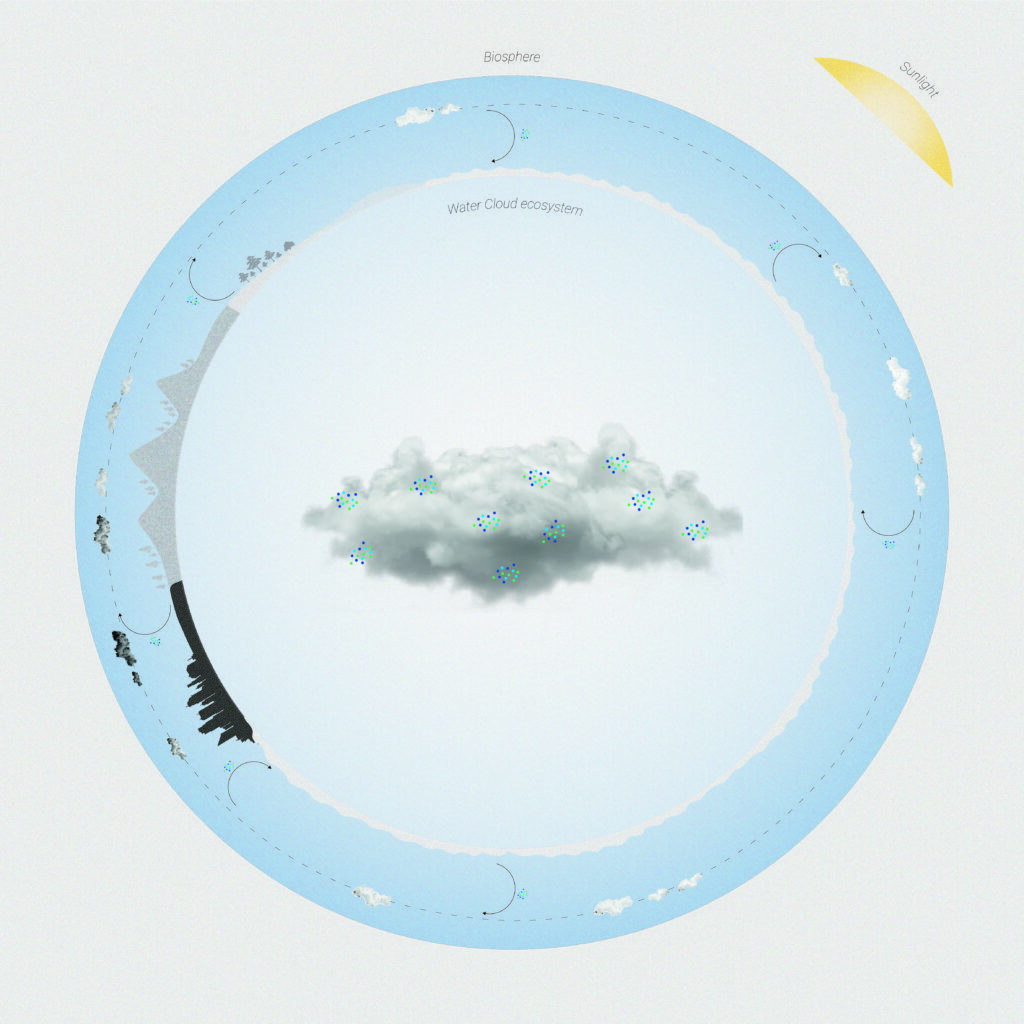
When we look at a cloud, it appears light and distant, almost abstract. Yet the atmosphere is alive. Each year, air currents lift millions of tons of microscopic life into the sky — bacteria, fungal spores, algae — originating from forests, oceans, soils, deserts, and cities. These invisible organisms travel through the troposphere, carried by wind and moisture across continents.
Clouds are not simply condensed vapor. They are dynamic environments shaped by sunlight, temperature, particulate matter, and living cells. Tiny airborne fragments act as nuclei around which water condenses. Within these suspended droplets, microorganisms endure extreme conditions — low oxygen, limited nutrients, cold temperatures, intense UV radiation. Some even contribute to the formation of rain and snow.
Eventually, this suspended life returns to the Earth, settling in new territories and continuing ecological cycles. What rises from one landscape may fall in another. The sky is not a boundary, but a shared field of circulation.
In this continuous movement, nothing remains isolated. Materials, organisms, and actions drift through interconnected systems, crossing territories and scales. Under the same air we all inhabit, what is made in one place quietly enters a wider exchange.